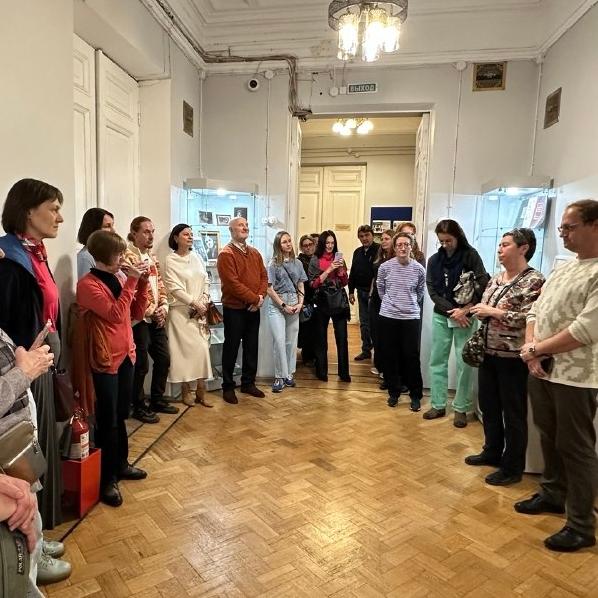
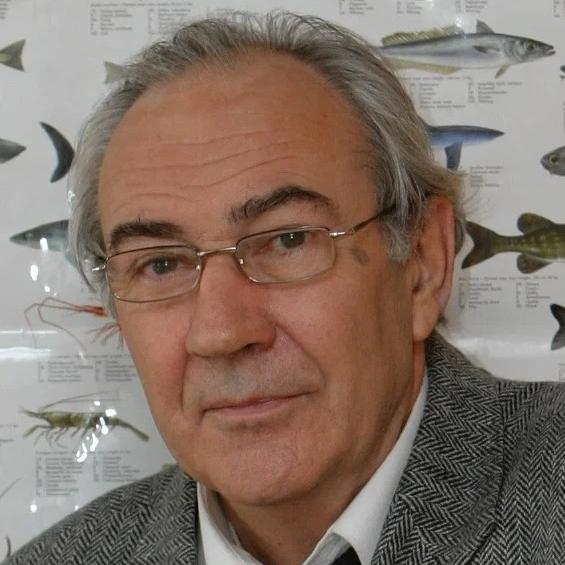
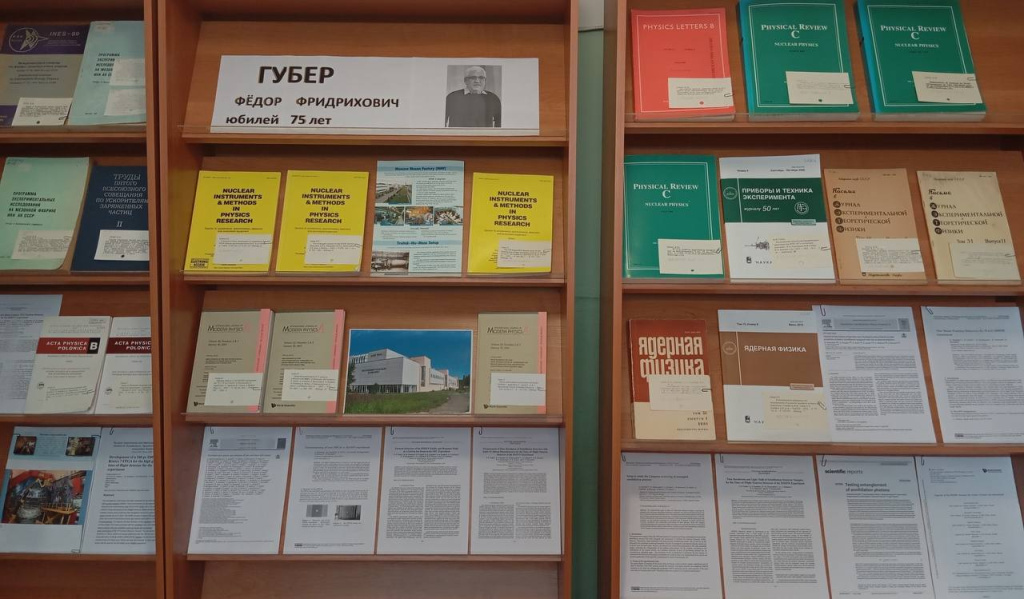
 4 августа в отделе БЕН РАН в ИЯИ откроется выставка публикаций ведущего научного сотрудника Института Федора Фридриховича Губера, посвящённая его юбилею.
Ф.Ф. Губер родился в августе 1950 г., работает в ИЯИ РАН с 1974 г. После окончания МГУ им. Ломоносова он предложил и расчитал магнитные каналы и спектрометры для пион-ядерной физики. Был координатором первого российско-итальянского эксперимента по образованию пионов, результаты которого легли в основу его кандидатской диссертации. Участвовал в создании установки КАСПИЙ в ОИЯИ и экспериментах на ней.
Основной научный интерес — релятивистская ядерная физика: модификация векторных мезонов в ядерной среде, фазовые переходы, поиск критической точки.
При его участии модернизировали установку NA50 в ЦЕРНе, что позволило обнаружить эффект подавления выхода J/psi в столкновениях ядер свинца.
Ф.Ф. Губер участвует в международных экспериментах NA61/SHINE, ALICE (ЦЕРН), HADES (GSI), CBM (FAIR, Германия).
Список изданий к выставке:
1. Всесоюзное совещание по ускорителям заряженных частиц (5; 1976; Дубна). Труды.... Т. 2. — 373 с., 2 л. черт. : ил.
https://koha.benran.ru/cgi-bin/koha/opac-detail.pl?biblionumber=2081765
2. Программа экспериментальных исследований на мезонной фабрике ИЯИ АН СССР : Тр. IV всесоюз. семинара, 23-27 апр. 1985 г. Звенигород. — М., 1986. — 455 с. : ил.
https://koha.benran.ru/cgi-bin/koha/opac-detail.pl?biblionumber=1949277
3. Программа экспериментальных исследований на мезонной фабрике ИЯИ АН СССР : Тр. V всесоюз. семинара, 12-15 апр. 1987 г., Звенигород / Науч. ред. М.В. Казарновский, В.Б. Копелиович. — М., 1987. — 436 с. : ил.
https://koha.benran.ru/cgi-bin/koha/opac-detail.pl?biblionumber=1949331
4. Acta Physica Polonica. B. Particle Physics and Field Theory. Nuclear Physics. Theory of Relativity. 2004.-т. 35 вып. 3. — ISSN 0587-4254.
https://koha.benran.ru/cgi-bin/koha/opac-detail.pl?biblionumber=609724
5. Acta Physica Polonica. B. Particle Physics and Field Theory. Nuclear Physics. Theory of Relativity. 2010. -т. 41 вып. 2. — ISSN 0587-4254.
https://koha.benran.ru/cgi-bin/koha/opac-detail.pl?biblionumber=609637
6. International Journal of Modern Physics. A.- 2005. - т. 20 вып. 2. — ISSN 0217-751X.
https://koha.benran.ru/cgi-bin/koha/opac-detail.pl?biblionumber=979232
7. International Journal of Modern Physics. A. 2007. - т. 22 вып. 2-3. — ISSN 0217-751X.
https://koha.benran.ru/cgi-bin/koha/opac-detail.pl?biblionumber=979175
8. International Journal of Modern Physics. A. 2009. - т. 24 вып. 2-3. — ISSN 0217-751X.
https://koha.benran.ru/cgi-bin/koha/opac-detail.pl?biblionumber=979154
9. Nuclear Instruments and Methods in Physics Research. A: Accelerators, Spectrometers, Detectors and Associated Equipment(до 1984г. см.: Nuclear Instruments and Methods in Physics Research). 1999.
Т. 435, вып. 1-2 : Vertex. 1998 / Ed. Loukas Dimitris, Markou Christos. — 1999. — XVI, 269 c. : ил., табл.
https://koha.benran.ru/cgi-bin/koha/opac-detail.pl?biblionumber=214007
10. Nuclear Instruments and Methods in Physics Research. A: Accelerators, Spectrometers, Detectors and Associated Equipment(до 1984г. см.: Nuclear Instruments and Methods in Physics Research). 2002.
-Т. 478, вып. 1-2 / ed. Jeitler M. [et al.]. — XX, 491 c. : ил., табл.
https://koha.benran.ru/cgi-bin/koha/opac-detail.pl?biblionumber=245092
11. Nuclear Instruments and Methods in Physics Research. A: Accelerators, Spectrometers, Detectors and Associated Equipment(до 1984г. см.: Nuclear Instruments and Methods in Physics Research). 2003.
Т. 502, вып. 1 : Experimental techniques of Cherenkov light imaging : proceedings / ed. Ekelof T. [et al.]. — 2003. — LI, 326 c. : ил., портр., табл.
https://koha.benran.ru/cgi-bin/koha/opac-detail.pl?biblionumber=245087
12. Physics Letters. B. Nuclear Physics and Particle Physics (предыдущее название до 1967г.: Physics Letters). -1989. - т. 221 вып. 3/4. — ISSN 0370-2693.
https://koha.benran.ru/cgi-bin/koha/opac-detail.pl?biblionumber=1273872
13. Physical review. C: Nuclear physics. – 1997. - т. 56 вып. 2. — ISSN 0556-2813.
https://koha.benran.ru/cgi-bin/koha/opac-detail.pl?biblionumber=1268025
14. Physical review. C: Nuclear physics. -1998. - т. 57 вып. 5. —ISSN 0556-2813.
https://koha.benran.ru/cgi-bin/koha/opac-detail.pl?biblionumber=1268015
15. Physical review. C: Nuclear physics. - 1999.- т. 59 вып. 2. — ISSN 0556-2813.
https://koha.benran.ru/cgi-bin/koha/opac-detail.pl?biblionumber=1268005
16. Письма в Журнал экспериментальной и теоретической физики / Российская академия наук. — 1980. - т. 31 вып. 11. — ISSN 0370-274X.
https://koha.benran.ru/cgi-bin/koha/opac-detail.pl?biblionumber=505082
17. Письма в Журнал экспериментальной и теоретической физики / Российская академия наук. — 1988. - т. 48 вып. 3. — ISSN 0370-274X.
https://koha.benran.ru/cgi-bin/koha/opac-detail.pl?biblionumber=504877
18. Приборы и техника эксперимента. - 2006.- вып. 5. — ISSN 0032-8162.
https://koha.benran.ru/cgi-bin/koha/opac-detail.pl?biblionumber=510686
19. Ядерная физика : журнал издается под руководством Отделения физических наук РАН / учредители: Российская академия наук, Институт теоретической и экспериментальной физики. — 1981. - т. 33 вып. 1. — ISSN 0044-0027.
https://koha.benran.ru/cgi-bin/koha/opac-detail.pl?biblionumber=590289
20. Ядерная физика : журнал издается под руководством Отделения физических наук РАН / учредители: Российская академия наук, Институт теоретической и экспериментальной физики. — 2012. - т. 75 вып. 6. — ISSN 0044-0027.
https://koha.benran.ru/cgi-bin/koha/opac-detail.pl?biblionumber=590546
21. Analytical description of the time-over-threshold method based on time properties of plastic scintillators equipped with silicon photomultipliers / Karpushkin N.,Finogeev D., Guber F.., Lyapin D., Makhnev A., Serebryakov D. // NIM A. – 2024. – V. 1068. – 169739.
Abstract. A new highly granular neutron detector (HGND) for the identification and energy measurement of neutrons produced in nucleus–nucleus interactions at the BM@N experiment, Dubna, Russia, at energies up to 4 AGeV is under development. The detector consists of approximately 2000 fast plastic scintillators, each with dimensions of 40 × 40 × 25 mm3 , equipped with SiPM (Silicon Photomultiplier) with an active area of 6 × 6 mm2 . The signal readout from these scintillators will employ a single-threshold multichannel Time-to-Digital Converter (TDC) to measure their response time and charge using the time-over-threshold (ToT) method. This article focuses on the analytical description of the signals from the plastic scintillator detectors equipped with silicon photomultipliers. This description is crucial for establishing the ToT to charge relationship and implementing slewing correction techniques to improve the time resolution of the detector.
https://www.elibrary.ru/item.asp?id=74410735
22. Commissioning of new FHCal at BM@N experiment/ Izvestnyy A , Golubeva M., Guber F. , Ivashkin A., Karpushkin N. , Morozov S. , Petukhov O. // Journal of Physics: Conference Series. -2022.- 2374. – 012023.
Abstract. The BM@N (Baryonic Matter at Nuclotron) is the fixed target experiment at NICA-Nuclotron (JINR, Dubna, Russia) accelerator complex. The main goal of the experiment is studying the properties of dense nuclear matter produced in ion-ion collisions at the energies of up to 4 AGeV. New Forward Hadron Calorimeter (FHCal) with modular structure and a beam hole in the center has been developed and constructed to measure the collision centrality after the BM@N upgrade. The transverse and longitudinal segmentation of the FHCal allows to perform calibration of the calorimeter with cosmic muons. FHCal modules have lead/scintillator sampling structure with longitudinal segmentation. Light signals from the sections are collected with MPPCs, amplified and read-out by ADC boards. Fast analog signals are collected for trigger system. The status of development and construction of the new FHCal calorimeter for the BM@N experiment is presented. Performance of FHCal front-end and readout systems is discussed.
https://iopscience.iop.org/article/10.1088/1742-6596/2374/1/012023
23. Correlated pion-proton pair emission off hot and dense QCD matter/ Adamczewski-Musch J., … Guber F. et al.// Physics Letters B. – 2021. –V.819. – P.136421.
Abstract. In this letter we report the first multi-differential measurement of correlated pion-proton pairs from 2 billion Au+Au collisions at √sN N = 2.42 GeV collected with HADES. In this energy regime the population of Δ (1232) resonances plays an important role in the way energy is distributed between intrinsic excitation energy and kinetic energy of the hadrons in the fireball. The triple differential d3N/dMπ± pdpTdy distributions of correlated π±p pairs have been determined by subtracting the πp combinatorial background using an iterative method. The invariant-mass distributions in the Δ (1232) mass region show strong deviations from a Breit-Wigner function with vacuum width and mass. The yield of correlated pion-proton pairs exhibits a complex isospin, rapidity and transverse-momentum dependence. In the invariant mass range 1.1 < Minv(GeV/c2) < 1.4, the yield is found to be similar for π+p and π−p pairs, and to follow a power law (Apart)α, where (Apart) is the mean number of participating nucleons. The exponent α depends strongly on the pair transverse momentum (pT) while its pT-integrated and charge-averaged value is α = 1.5 ± 0.08st ± 0.2sy.
https://www.sciencedirect.com/science/article/pii/S0370269321003610?via%3Dihub
24. Development of a High Granular TOF Neutron Detector for the BM@N Experiment / F. F. Guber F.F., Golubeva M.B., Zubankova A.A. et al. // Instruments and Experimental Techniques, 2024, Vol. 67, No. 3, pp. 447–456.
Abstract. This article describes the design of the HGND detector (High Granular Neutron Detector) for measuring azimuthal neutron fluxes in the range from 300 to 4000 MeV as well as heavy ions formed in nucleus-nucleus collisions at energies up to 4 AGeV in the BM@N (Baryonic Matter at Nuclotron) experiment on the extracted beam of the JINR Nuclotron, Dubna. The detector consists of 16 layers of plastic scintillation detectors having a cellular structure with copper absorption plates between the layers. The results of measuring the time resolution of scintillation cells using silicon photodetectors are presented. The proposed electronics circuit for reading signals from scintillation cells is described. The results of modeling the acceptance of a neutron detector, the efficiency of neutron detection, the neutron energy resolution, and an estimate of the neutron count rates for the Bi + Bi reaction at an energy of 3 AGeV are presented.
https://link.springer.com/article/10.1134/S0020441224700702
25. Development of a 100 ps TDC based on a Kintex 7 FPGA for the high granular neutron time-of-flight detector for the BM@N experiment/ Guber F., Izvestnyy A., Karpushkin N., Makhnev A., Morozov S., Serebryakov D. // NIM A. – 2024. – V. 1059. – 168952.
Abstract. The prototype of a TDC board has been developed for the new high granular time-of-flight neutron detector (HGND). The board is based on the standard LVDS 4x asynchronous oversampling using the xc7k160 FPGA with a 100 ps bin width. The HGND is being developed for the BM@N (Baryonic Matter at Nuclotron) experiment to identify neutrons and to measure their energies in heavy-ion collisions at ion beam energies up to 4 A GeV. The HGND consists of about 2000 scintillator detectors (cells) with a size of 40×40×25mm3 and light readout with EQR15 11-6060D-S photodetectors. To measure the time resolution of the scintillator cells, the two-channel FPGA TDC board prototype with two scintillator cells was tested with an TDC board prototype with two scintillator cells was tested with an electron beam synchrotron at the LPI institute (Moscow, Russia). The measured cell time resolution is 146 ps, which is in a good agreement with the 142 ps time resolution measured with a 12-bit @ 5 GS/s CAEN DT5742 digitizer. For the full HGND, the TDC readout board with three such FPGAs will read 250 channels. In total, eight such TDC boards will be used for the full HGND at the BM@N experiment.
https://www.elibrary.ru/item.asp?id=64945409
26. Forward Detectors of the BM@N Facility and Response Study at a Carbon Ion Beam in the SRC Experiment/ Volkov V.V. , Golubeva M. B, Guber F. F., Zubankov A.A. , Ivashkin A.P., Izvestny A.V. , Karpushkin N.M., Makhnev A.I. , Morozov S.V., Petukhov O.A.// Instruments and Experimental Techniques – 2023. - Vol. 66, No. 2. - pp. 218–227.
Abstract. A number of forward detectors were created when upgrading |the BM@N experiment: a forward hadron calorimeter (FHCal) for measuring the energy of spectator fragments as well as a beam quartz hodoscope (FQH) and a scintillation wall (ScWall) for identifying such fragments. These detectors are intended to determine the centrality and orientation of the reaction plane as well as to study the charge distributions of spectator fragments produced in nucleus−nucleus interactions. The response of the forward detectors has been measured in the SRC experiment on the study of the short-range correlations in interactions of carbon ions with a momentum of 3.5 AGeV/c in a liquid hydrogen target.
https://www.elibrary.ru/item.asp?id=61524055
27. Measurement of Time Resolution of Scintillation Detectors with EQR-15 Silicon Photodetectors for the Time-of-Flight Neutron Detector of the BM@N Experiment/ Guber F.F. , Ivashkin A. P. , Karpushkin N.M., Makhnev A.I. , Morozov S.V., Serebryakov D.V., et al.//Instruments and Experimental Techniques, 2024, Vol. 67, No. 3, pp. 443–446.
Abstract. To study the dependence of the equation of state of high-density nuclear matter on the term characterizing the isospin (proton–neutron) asymmetry of nuclear matter, it is necessary to measure azimuthal flow of neutrons as well as azimuthal flow of charged particles from a dense nuclear matter in the nuclear– nuclear collisions. For this purpose, the Institute for Nuclear Research (Russian Academy of Sciences) is developing a new high-granular neutron detector that will be used in the BM@N experiment at the extracted beam of the Nuclotron accelerator at the Joint Institute for Nuclear Research (JINR, Dubna). This detector will identify neutrons and measure their energies in the heavy-ion collisions up to 4 GeV per nucleon. This article presents the results of measurements of the time resolution and light yields of samples of scintillation detectors with sizes 40 × 40 × 25 mm3 that will be used in a neutron detector based on the currently available fast plastic scintillator manufactured by JINR using an EQR15 11-6060D-S photodetector for light readout. For comparison, the results of measurements for a detector of the same size with a EJ-230 fast scintillator and with the same type of photodetector are given. The measurements were made on cosmic muons as well as on the Pakhra electron synchrotron of the Lebedev Physical Institute of the Russian Academy of Sciences located in Troitsk, Moscow.
https://link.springer.com/article/10.1134/S0020441224700696
28. New Beam Position Detectors for NA61/SHINE experiment/ Makhnev A. , Guber F., Serebryakov D. , Pulawski S. , Kowalski S.// Journal of Physics: Conference Series. – 2022. – 2374. -012057.
Abstract. The NA61/SHINE experiment at the CERN SPS is undergoing a major upgrade during the CERN Long Shutdown 2 period (2019-2021). The upgrade is essential to fulfill the requirements of the new open charm and neutrino programs. In these programs the NA61/SHINE will operate with the data acquisition rate increased by a factor of 10, which requires an upgrade of current Beam Position Detectors (BPDs). New detectors should monitor beam particle positions with a frequency up to 105 Hz. This paper presents an overview
of the new BPD design, as well as discusses current state of development and prototype production of BPD, including: mechanical design, front-end electronics design and integration with experiment’s data aquisition system.
https://www.elibrary.ru/item.asp?id=58701809
29. Setup to study the Compton scattering of entangled annihilation photons/ Strizhak A. , Abdurashitov D. , Baranov A. , Borisenko D. , Guber F. , Ivashkin A. , Morozov S. , Musin S. , Volkov V. // Journal of Physics: Conference Series . – 2022. -2374.- 012041.
Abstract. The experimental setup to study the difference between Compton scattering of entangled and decoherent annihilation photons is discussed. The pairs of entangled gammas are born in electron-positron annihilation at rest. The polarization state of each photon in such a pair is not definite and represents the superposition of horizontal and vertical polarizations, while the relative polarizations of the photons are orthogonal. After interaction with the environment (for example, via the Compton scattering) the entangled pair of photons is broken and the pair becomes decoherent with determined polarizations of both gammas. Since the Compton scattering depends on the polarization of the initial photon, the scattering kinematics of entangled and decoherent photons might be quite different. At present, there is no experimental comparison of the Compton scattering kinematics for entangled and decoherent gammas.
https://www.elibrary.ru/item.asp?id=58752967
30. Testing entanglement of annihilation photons/ Ivashkin A., Abdurashitov D. , Baranov A., Guber F. , Morozov S. , Musi S, Strizhak A.,Tkachev I. // Scintific reports.- V.13, No.1. – 7559.
Abstract. We present a new experimental study of the quantum entanglement of photon pairs produced in positron-electron annihilation at rest. Each annihilation photon has an energy that is fve orders of magnitude higher than the energy of photons in optical experiments. It provides a unique opportunity for controlled Compton pre-scattering of initial photons before the polarization measurements. The experimental setup includes a system of Compton polarimeters to measure the angular correlations of annihilation photons in initial and thus prepared pre-scattered states. For the frst time, a direct comparison of the polarization correlations of initial and pre-scattered annihilation photons has been carried out. The angular distributions of scattered in polarimeters photons turned out to be the same for both types of events. Moreover, the correlation function in the Bell’s inequality is also the same for both states. We discuss the implications of our results for quantum measurement theory and for the quantum-entangled positron emission tomography.
https://www.elibrary.ru/item.asp?id=61426419
31. Time Resolution and Light Yield of Scintillation Detector Samples for the Time-of-Flight Neutron Detector of the BM@N Experiment/ Guber F. F., Ivashkin A. P., Karpushkin N.M., , Makhnev A.I., Morozov S.V., Serebryakov D.V. // Instruments and Experimental Techniques, 2023, Vol. 66, No. 4, pp.553-557.
Abstract. A new compact time-of-flight neutron detector is being planned for the identification and energy measurement of neutrons produced in nucleus-nucleus interactions at energies up to 4 AGeV at the BM@N experiment, located at the Nuclotron (Joint Institute for Nuclear Research, Dubna, Russia). This detector will be used to measure neutron yields and azimuthal flows, which should be sensitive to the equation of state of dense nuclear matter, as shown in various theoretical models It is proposed to use plastic scintillators produced at JINR and IFTP and silicon photomultipliers with a sensitive area of 6 × 6 mm2 for photon registration, one for each scintillation cell. To achieve the required neutron energy resolution (of the order of several percent) in the energy range up to 4 GeV, the time resolution of scintillation detectors should be 100−150 ps. The concept of a time-of-flight neutron detector is discussed. The results of measurements of the light yield and time resolution of several scintillation detector specimens of various sizes and two types of silicon photomultipliers are presented.
https://www.elibrary.ru/item.asp?id=62362663
32. Upgrade of the BM@N detector for studies of heavy ion interactions/ Maksymchuk A., Guber F. et al.// Int.J. Mod.Phys. Conf.Ser. -2023.-V. 51. – 2361013.
Abstract. In the next years the Baryonic Matter at Nuclotron (BM@N) experiment at Joint Institute for Nuclear Research (JINR) will carry out the physics program with heavy ion beams with energies up to 3.9 AGeV and intensities up to 2 ⋅ 106⋅ 106 ions/s. The experiment is devoted to measure observables sensitive to the equation of state of dense baryonic matter. To meet this goal the existing BM@N set-up will be upgraded with fast hybrid tracking system, which includes beam tracking detectors, a large aperture silicon tracking system, gas electron multiplier stations and cathode strip chambers. The measurement of the event plane and centrality will be achieved with a forward hadron calorimeter and granular hodoscopes. The physics program and configuration of the upgraded BM@N set-up are presented.
https://www.elibrary.ru/item.asp?id=64626520